Friday, May 3, 2013

Treasures of Tutankhamun

Tomb Tutanhomon after more than three thousand years has come down to us almost intact, is considered one of the most important discoveries in archeology. Since 1922, when Howard Carter discovered the burial in the "Valley of Kings" near Thebes, a little-known Tutanhomon became perhaps the most famous pharaoh in history. Inside the tomb British Carter and Lord Carnarvon discovered numerous decorations, household items, furniture, works of art of that era, as well as a gold sarcophagus weighing more than 110 pounds with the mummified body of the young king of ancient Egypt.
From March 9 to September 1, 2013 Tutanhomona sarcophagus and treasures from the tomb can be seen in a unique exhibition in Berlin.


The Pharaoh of the XVIII dynasty of the New Kingdom rules about 9 years old, with about 1332 to 1323 years BC (died 19 years of age).


 The Rosetta Stone - a plate, found at the end of XVIII century in Egypt near the town of Rosetta. It is stamped identical within the meaning of the text in three languages, two ancient Egyptian and Greek. He served as the starting point for deciphering Egyptian hieroglyphics


 The treasures of the tomb.


 Anubis in the form of a dog.


Wall Paintings.


 Sarcophagus


 And the famous tombstone mask of Tutankhamun.


 Other treasures.


Tutankhamun with a harpoon.

 Golden statue of Tutankhamun, riding on the back of a black leopard.

 Anubis in the form of a dog.


 Pharaoh's throne.

 Other treasures.


 Ceremonial throne.

 Before they reach their age of 20, Tutankhamun died (and perhaps killed), and was buried in a tomb in the "Valley of Kings" near Thebes.

 November 26, 1922 English Egyptologist Howard Carter and Lord Carnarvon archeologist were the first in more than three thousand years later in the tomb. All the artifacts were photographed, numbered and described.

Monday, April 8, 2013

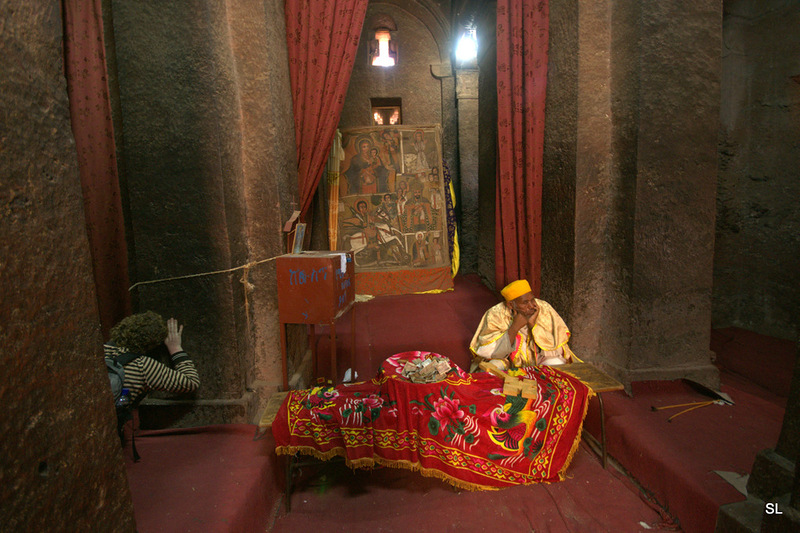
Lalibela. Church in Ethiopia

The main shrine Lalibela - 11 monolithic, carved in volcanic tuff nave churches.


Built these churches - King Gebre Meskel Lalibela of the dynasty Zagwe


According to the calculations of archeologists, so he drew about 40,000 people.


Lalibela tried to build a New Jerusalem in response to the capture of the "old" Israel, Muslims in 1187.


That is why many objects in town are of biblical names: flowing in a river called the Jordan, although Jordan is very birthplace of Christ removed from the capital.


Is there and such churches as Bete Golgota - Holy Sepulcher and the Bat Medhane Alem - Church of the Savior.


First Church of Christ the Savior Cathedral, Bet Medhane Alem (Beta Medan Alem).


It contains the cross of Lalibela.


Underground tunnel goes into the next temple, Maryum. Church of Our Lady.


It is a rectangular church is the most ornate church of Lalibela.


Beta Golgotha ​​(Calvary Bethe) (home of the tomb of King Lalibela), Debre Sina.


The Church of St. George - built in the shape of a cross at the top and has a beautiful view - in a deep pit is a building height of forty feet, carved into the rock cross.


The church which is located in a cave.


Monday, September 3, 2012

Luxor

Luxor, a city on the site where a few thousand years ago was the capital of ancient Egypt - Thebes. This and a number of various antiquities, which attract millions of tourists. Generally ancient Thebes consisted of two parts - the "city living", where the pharaohs ruled, and "City of the Dead", where they were buried.


Statues of Amenhotep III. Earlier they were standing in front of the funerary temple of Pharaoh, but for three thousand years, the Nile washed away the temple, and statues themselves in the 27th BC damaged by the earthquake. One statue obtained from cracks in the ancient world has earned the reputation of a "singing", so that even in those years here were pulled crowds.


Temple of Hatshepsut.


The view from the temple in the neighborhood


Valley of the King It is a place where thousands of years buried their dead pharaohs. The most famous is the tomb was discovered the tomb of the pharaoh Tutankhamun, discovered in 1922, together with all the gold ornaments. All other tombs were looted long ago. What is interesting, as it now appears, looting engaged contemporaries pharaohs. They simply bribed officials, who had to watch the graves, and were left there to dig the treasure.


The last point of the program - funerary temple of Ramses III - Medinget Abu. The temple is quite well preserved, and is particularly well preserved inscriptions on its walls depicting the attack on Egypt some "Sea Peoples" and the victory of Ramesses III over them.